Comers Core · OMS
An ecommerce OMS that connects the entire order workflow
Comers OMS brings orders from connected marketplaces and sales channels into one consistent operational model. Instead of treating an order as an isolated record, it keeps it connected to the customer, products, payment, inventory, warehouse work, shipping, conversations and after-sales activity.
- Orders from multiple channels in one model
- Full context from purchase to after-sales work
- One workspace for operations, warehouse and support
- Agent Comers working on the same context as the team
01 · more than another order list
One order. The complete operational context.
In many systems an order ends with an order number, a status and a few buyer details. The rest of the work lives elsewhere: inventory in another module, the parcel in a carrier portal, marketplace messages in a separate inbox, and a complaint in another system again.
Comers treats the order as a central part of the operating process. Data from different channels is normalized into one model, while the order stays connected to what happened before and after the sale.
- eBay
- Amazon
- WooCommerce
- Own store
- source
- eBay DE
- received
- Jul 1, 7:05 PM
- ship by
- Jul 3, 9:59 PM
- value
- €105.99
- shipment
- Dispatched
- cases
- 1 open
From the same context your team moves to the customer, products, payment, inventory, shipment, conversations, documents and after-sales cases.
- customerKarl Neumann
- listings and products1 item · RT-1002
- paymentPaid · €105.99
- inventoryStock and reservation
- shippingDE_DHLPaket
- messages & after-salesConversation · return · case
02 · multiple channels, one way of working
Handle orders from different channels consistently
Every marketplace and store has its own API, statuses, identifiers and way of representing an order. Comers separates those integration differences from the day-to-day operating model used by your team.
Orders from connected channels are normalized into a shared operational model — your team filters and works with them by status, source, shipment or due date without switching between sales-channel dashboards.
The marketplace defines where the order came from. Comers defines how your operation works with it.
Explore multichannel operations- Marketplace AorderId · fulfillmentStatus · buyerRef · lineItems[]
- Marketplace Border_no · state · customer{} · positions[]
- Own storeid · status · payment · items[] · shipping{}
- order_no
- 19-62930-40286
- source
- eBay DE
- status
- In progress
- due_date
- 2026-07-03
- shipment
- Dispatched
- buyer
- Karl Neumann
03 · from placement to resolution
The full order lifecycle on one operational timeline
Comers keeps the stages of fulfillment and the events around an order in one connected context.
-
The order enters Comers
The integration retrieves channel data and Comers normalizes it into its own model.
-
The team sees what needs action
Filter by status, source, shipment or due date.
-
Fulfillment uses inventory context
The order stays connected to the products and stock behind the sale.
-
Shipping stays part of the order
Parcel, dispatch status, tracking and history remain on the order.
-
Conversations keep their context
Messages sit next to the order, customer, products and shipment.
-
Operations do not end at dispatch
Returns, exchanges, complaints and repairs stay connected to the order.
final outcome
Completed Cancelled04 · real product view
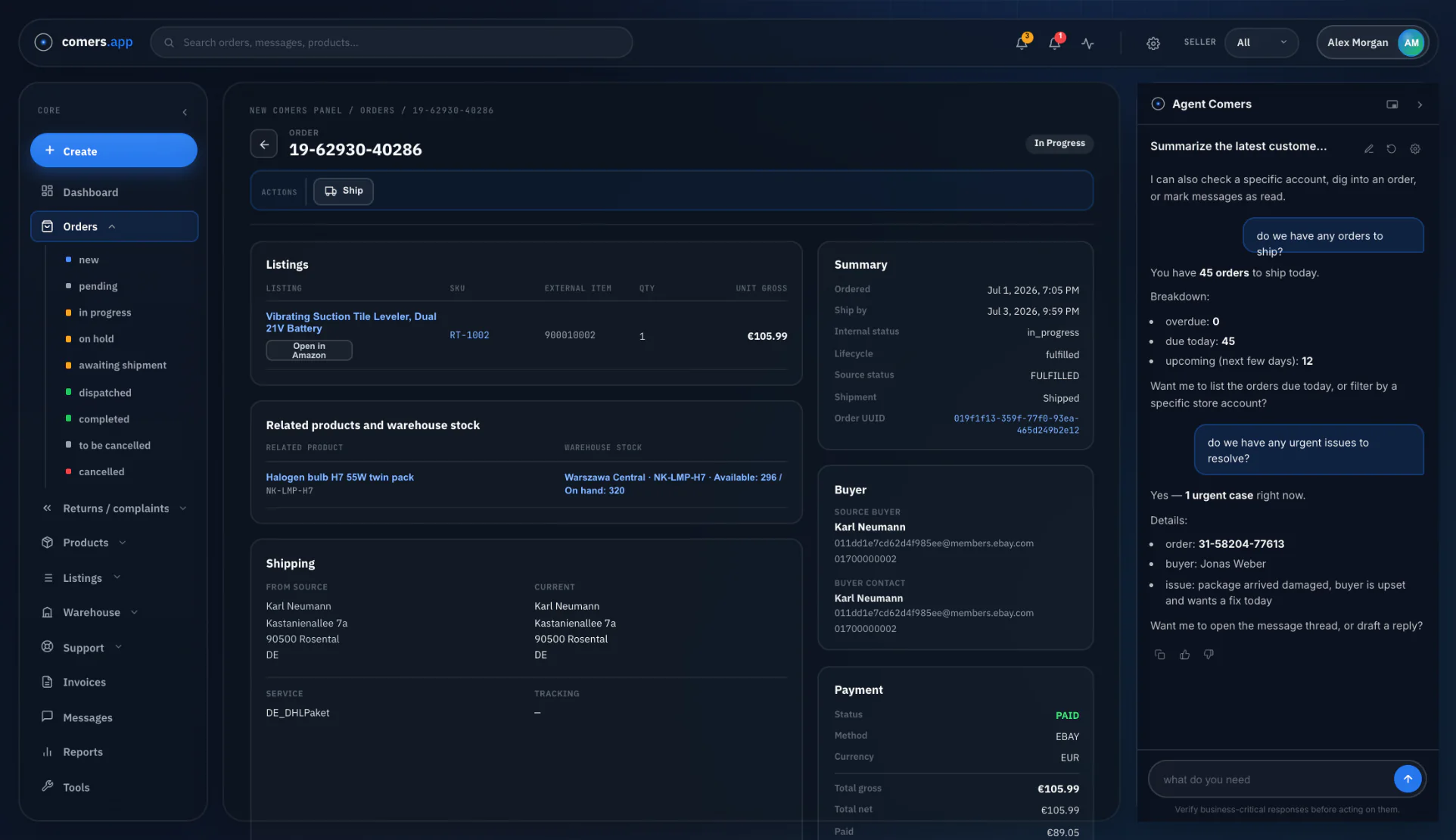
Products, buyer, payment, shipment and history in one place
An order view should answer “what is happening with this sale?” without requiring several other systems to be opened first.
Comers connects the information needed for daily operations and fulfillment: buyer details, products, payment, shipment and the order timeline. The same source of information is available to operations, support and Agent Comers.
- listings
- product + warehouse stock
- shipping + tracking
- buyer and payment
05 · inventory and shipping
Order management should not stop at changing a status
An OMS delivers more value when it participates in fulfillment instead of merely observing orders.
In Comers the order is connected to warehouse and shipping modules. Products can be linked to the real stock items behind them, while tracking and shipment history stay associated with the order.
- 19-62930Order
- −1 pcProduct and warehouse stock
- DHLShipment
- in transitTracking and history
06 · messages and after-sales
Context does not disappear after dispatch
A question about a delayed parcel, an exchange request or a complaint is not an unrelated new event. Each one comes from an earlier sale.
Comers can keep conversations and after-sales cases connected to the order, customer, products and shipment — the person answering the customer does not have to search several dashboards first.
- origin of the case19-62930-40286
- message“When will my parcel arrive?”
The conversation is visible with the order, shipment and products.
→ order · shipment - returnReturn requested for an item
The return inherits sale, product and payment context.
→ order · product - caseComplaint — damaged parcel
The support case links the conversation, shipment and decision.
→ conversation · shipment
07 · agent inside the order workflow
An agent that sees more than the prompt
Agent Comers works inside the operation and uses connected context across Core modules: orders, customers, products, listings, inventory, shipments, messages and after-sales cases.
An operational request does not have to repeat the entire history of the case. For supported workflows the agent can prepare or execute actions according to permissions, company instructions and approval requirements.
- Show orders that are due to ship today but do not have a ready shipment yet.
- Which orders have an open customer case that needs attention before dispatch?
- Summarize this order history and the customer conversation.
Show orders that are due to ship today but do not have a ready shipment yet.
7 orders due today have no shipment created. 3 of them have an open customer case.
- 19-62930-40286 no shipment
- 31-58204-77613 open case
- 22-90311-10574 ready to dispatch
// actions follow permissions and approval rules
context it works on
- Orders
- Customers and conversations
- Products and listings
- Inventory and warehouse
- Shipments
- After-sales cases
08 · history instead of silent overwrite
Know what happened, not only the current status
Important operational changes should preserve relevant history. Teams can reconstruct an order timeline, understand a status change and attribute actions performed by people, automation and Agent Comers.
current state
Shipped
A status alone only answers “what is true right now”.
what happened
- Return case opened
- Parcel dispatched — DE_DHLPaket
- Reply drafted by the agent
- Status changed to in_progress
- Payment confirmed
09 · deployment
The same operating model, two deployment options
Comers Core can run as a managed service or in an organization’s own infrastructure. The deployment model does not change the underlying idea: orders and the processes around them remain part of one connected operating environment.
Comers Core
FAQ
Frequently asked questions
What is an OMS?
An OMS (Order Management System) manages the lifecycle of orders. In ecommerce it can bring together orders from multiple sales channels and support the process from intake through fulfillment and shipping to after-sales work.
Is Comers an OMS?
Yes. Order management is one of the core areas of Comers Core. Comers normalizes orders from connected channels into a shared operational model and connects them to products, inventory, shipping, messages and after-sales work.
Can Comers manage orders from multiple marketplaces?
Yes. Comers is designed to work with multiple marketplaces, stores and sales accounts in one operational model. The channels actually available depend on the current integration set.
Does Comers replace every marketplace dashboard?
The purpose of Comers is not to duplicate every function of every sales channel. It retrieves and normalizes the data needed for shared operational work, while channel-specific capabilities may still depend on each integration and external API.
Are orders connected to inventory and shipping?
Yes. An order can stay connected to products and stock, while the shipping process uses both order and warehouse context. Shipment and tracking information remain associated with the order history.
Does Agent Comers have access to order context?
Agent Comers is designed to use Comers’ connected operational context, including orders, customers, products, inventory, shipments, messages and after-sales cases. The actions available depend on supported capabilities, permissions and approval rules.
Can Comers OMS run self-hosted?
Comers Core can run as a managed service or in an organization’s own infrastructure.
See order management with the full context attached
If you operate across several sales channels and want to stop reconstructing every order from separate dashboards, start using Comers on the Free plan.